
Last updated November 18, 2026
 Wrought iron
 Wood & steel frame
 Farm & ranch
 Sliding driveway gates
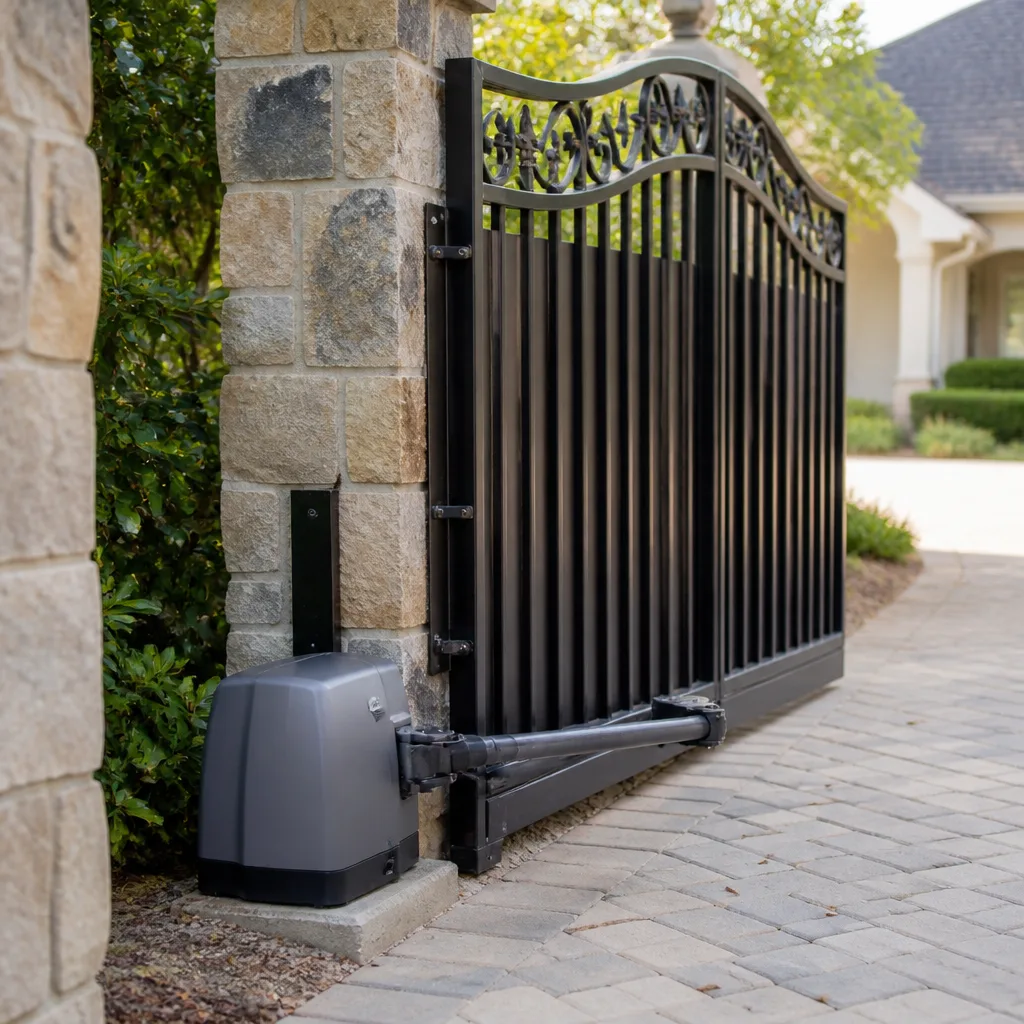 LiftMaster operators
Free on-site gate assessment - hinges, posts, and your LiftMaster or Nice gate operator checked before anything is quoted
The assessment is free and the quote is the invoice.
Get your free estimateDIY vs Professional Gate Motor & Opener: What’s Safe to Do Yourself
Most gate work isn’t dangerous. Some of it is. The line between the two isn’t where YouTube suggests, and it usually isn’t about whether you own a socket set. Hal doesn’t mind a homeowner swapping a battery backup or wiping down a photo-eye lens, but the calls that keep him up at night come from people who wired their own entrapment protection loop and got the polarity backwards, then stood back and watched a gate close on a kid’s bike. This guide is about that line. We’ll walk through what a Sunrise Manor homeowner can safely do on a Saturday, what will land you in the ER or in front of a lawyer, and the honest math on when calling is cheaper than saving.
Quick Answer
Battery replacement, photo-eye cleaning and alignment, remote programming, and limit adjustment on digital-display operators are genuinely safe for a careful homeowner. Anything that touches 120-volt line power, the entrapment protection wiring loop, or the geometry between an operator arm and an articulated gate crosses into injury territory, and UL 325 safety-device misconfiguration is both a physical hazard and a liability exposure. If the task requires opening the motor housing or running a wire to a breaker, call a gate professional who is licensed and insured.
Styles & brands we work with
- Wrought iron
- Wood & steel frame
- Farm & ranch
- Sliding driveway gates
- LiftMaster operators
Table of Contents
- The Three Categories That Decide Whether It’s DIY
- What’s Genuinely Safe to Do Yourself
- Tasks That Look Simple But Aren’t
- UL 325 Entrapment Protection Explained
- The “I’ll Save Money” Math
- When You’ve Already Done Phase One Yourself
- Sunrise Manor Specifics That Change the Answer
The Three Categories That Decide Whether It’s DIY
Forget “handy” versus “not handy.” That’s not the real question. The real question is which category the job falls into, because each one has a different failure mode and a different cost when it goes wrong.
Category one is low voltage and no structural load. Think a nine-volt battery in the backup, a wiped photo-eye lens, a re-pair of remotes, a limit tweak on a modern LiftMaster with a digital display. These jobs have a clear right and wrong, they don’t hurt you when you get them wrong, and the worst outcome is a gate that opens a little too far.
Category two is line voltage. Anything that connects to 120V household power or a dedicated circuit by the gate post. The gate motor itself runs on low voltage, but the transformer feeding it does not. Every year we get called out to a Sunrise Manor gate where a homeowner tapped into a sprinkler valve circuit to save a run to the panel. That works fine until it doesn’t.
Category three is mechanical load and safety geometry. The operator arm’s attach point on the gate leaf, the hinge post, the sag that appears after six summers, the entrapment device placement and calibration. Get this wrong and the gate looks fine for weeks, then shears a bolt or fails to reverse on a contact. That’s the category that produces lawsuits.
Three categories. One of them is a weekend project. Two aren’t.
What’s Genuinely Safe to Do Yourself
If it lands in category one, have at it. These are the tasks we tell people to handle on their own, and we mean it. We’re not going to pretend a battery swap needs a service call.
Battery backup replacement. Most residential operators in Sunrise Manor use a sealed backup battery behind the housing door. Kill the power at the breaker, wait for the operator to finish its travel cycle, disconnect the two leads, swap the battery, reconnect, restore power. Fifteen minutes. The mistake we see is buying a generic 7Ah battery from a big-box store and wondering why the gate only survives a two-hour outage. Use the OEM battery the manufacturer specifies, usually a 12V sealed lead-acid sized for your model.
Photo-eye cleaning and alignment. Dust, spider webs, and the fine grit that blows through the east side of the valley constantly will fog the lens. A microfiber cloth and a check that the two eyes point at each other will fix most “gate won’t close” calls. Align them by sighting the LED indicator on one unit and adjusting the other until it holds steady.
Remote and keypad programming. Every modern opener has a pairing sequence printed on the inside of the housing door or in the manual. LiftMaster and Elite units use a learn button; Mighty Mule uses a control board sequence. Adding a remote or changing a keypad code is safe, reversible, and takes a few minutes.
Limit adjustment on digital-display operators. Newer LiftMaster and FAAC operators with an LCD screen walk you through limits in the menu. You’re changing how far the gate travels, not how hard it pushes. If your model uses physical potentiometer screws and a handheld tachometer, that’s a different job and we’d rather you didn’t.
That’s the whole safe list. Everything else on a gate opener is either electrical work or mechanical work with a safety device attached to it.
Tasks That Look Simple But Aren’t
These are the ones that get people in trouble, and every one of them looks easy on video.
Connecting the 120V hardwire. The transformer or dedicated circuit that feeds the operator has to be run correctly, from the panel, through the correct conduit, to a junction box that meets code. Sunrise Manor sits in unincorporated Clark County, and the electrical inspection requirements for outdoor gate circuits fall under county code rather than city code, which trips up people who’ve done panels inside the Las Vegas city limits and assume the rules travel the same. Get the conduit burial depth wrong, get the bonding wrong, or skip the GFCI and you’ve built a shock hazard sitting in your own yard.
Entrapment protection device wiring. Photo-eyes and safety edges connect to the control board through specific terminals that expect specific signals. Polarity matters. Normally-open versus normally-closed matters. Get it backwards and the operator will either refuse to close and throw a fault code, or worse, close and never read the safety device. We’ve walked up to gates in Sunrise Manor where a homeowner wired photo-eyes to the accessory power terminals by mistake; the eyes lit up, the gate moved, and the safety circuit was dead the entire time.
Operator-to-gate arm geometry on articulated systems. The attach point on a swing gate leaf isn’t arbitrary. It’s set by the arm length, the hinge offset, and the swing arc. Put it two inches off and the operator will work for a month, then start straining against the limit, chew through gear teeth, and warp the arm bracket. On FAAC and BFT swing operators, that geometry is what keeps the arm from overextending past its full swing and binding on the return.
Limit adjustment on analog operators. If your unit uses a potentiometer and a tachometer-driven board rather than a digital display, we count that as a pro task. You can cook the board by turning the wrong trim pot.
UL 325 Entrapment Protection Explained
UL 325 is the safety standard that governs automatic gate operators, and it exists because people have been killed by gates. It’s not a marketing badge. It requires that an operator either sense an obstruction or have an external device (photo-eyes, safety edges, or both) that tells it to reverse when something enters the path.
The part DIY guides skip is the configuration. The safety device must be wired, calibrated to the correct sensitivity, and tested by actually walking an obstruction into the gate path while the gate is moving. Most homeowners never do the last step. A photo-eye that lights up green doesn’t prove the operator will reverse; it proves the eye has power. You have to verify the operator actually reads the signal.
Here’s how we test it on every job:
- Run the gate through a full open and close cycle with a clear path and confirm the reverse function never falsely triggers.
- Interrupt the photo-eye beam with a cardboard box mid-close and confirm the operator reverses immediately.
- Repeat the same test with a moving obstruction (a broom handle) and confirm the safety edge, if present, triggers the reversal.
- Check that the fault code, if any, clears when the obstruction is removed and the gate returns to normal operation.
If your gate fails any of those, especially number two, stop using it. Do not pass go on a closing cycle until a professional has looked at it. Sunrise Manor has a lot of stucco-walled driveways where the photo-eye mounted on the stucco side fogs with condensation every winter and starts giving false readings; we’ve seen gates set to a “force close” override that masked a dead safety device for an entire summer. That’s a lawsuit waiting to happen, and it’s exactly the setup a house-flipper install leaves behind.
The “I’ll Save Money” Math
Here’s the honest comparison, and it’s the part nobody wants to look at.
What a correct professional install costs. A residential swing or slide operator installed by a licensed gate contractor, with a proper electrical run, a fully tested UL 325 safety device, and a written warranty, typically lands where a homeowner expects. The number varies by brand (a Mighty Mule vs. a LiftMaster vs. a FAAC is a wide spread), by gate size, and by how much work the electrical run takes on your specific property. We quote in the driveway before we start, in writing, so the number you agree to is the number you pay.
What a failed DIY install costs. This is where the “I’ll save the labor” math falls apart. When a homeowner’s own install fails, it usually fails at the board or at the wiring, and both are the expensive parts. A cooked control board on a LiftMaster or a FAAC swing operator can run close to the price of the labor you thought you were saving. Then there’s the diagnostic trip to find the fault, the rework to fix what the first attempt broke, and the fact that no reputable contractor will warrant a motor they didn’t install until they’ve re-verified the entire electrical and safety setup. You pay twice, and you spent a weekend.
We’ve gone out to Sunrise Manor jobs where the homeowner had already spent more on two replacement boards and a new photo-eye set than the full professional install would have run. That’s not a “gotcha.” It’s the pattern.
When You’ve Already Done Phase One Yourself
We get this call a few times a month, and we want to say this clearly: there’s no lecture. You tried the project, you got part way, and now you want somebody to finish it. That’s a normal call and we treat it like any other.
What we do is walk the gate first, before we quote anything. We look at the electrical run and confirm it meets code. We open the housing and check the board for signs of a miswired safety device. We test the reverse function the same way we’d test a fresh install. We check the arm geometry against the gate specification. Then we give you a written number for the specific rework that’s needed, not a blanket “we have to start over.”
What we’ll stand behind: the work we redo, and any work we complete, is covered under the 90-Day Done Right Promise in writing. That means if the reworked piece fails, one call brings us back. What we can’t warrant is the segment you finished yourself that we didn’t touch. That’s not a penalty; it’s just the honest boundary of any warranty in this trade. If you want the entire system warranted, we rework the whole thing, and the written estimate tells you exactly what that includes.
If you did the battery swap and the photo-eye alignment and that’s the extent of your Phase One, we’ll probably tell you to keep the money. That work is fine. The line is where it always is: wiring, safety calibration, and load geometry. See our Gate Motor & Opener in Sunrise Manor page for the full scope of what we handle on the operator side.
Sunrise Manor Specifics That Change the Answer
Some of what makes a gate job risky here is local, and it’s worth knowing before you start.
The wind. Sunrise Manor sits in the east valley where spring and early summer wind gusts are strong enough to bend an unclipped photo-eye bracket. A DIY install that skips the mounting cleats and just screws the eye directly to stucco is going to misalign in the first big blow, and a misaligned eye on a gate set to auto-close becomes a “gate won’t stay closed” call by June. Anchor the eyes properly and check alignment every spring.
The heat. Control boards, batteries, and outdoor conduit expand and cool through a hundred-degree swing every year. Batteries in particular die two or three summers sooner than the spec sheet promises in this climate, which is why backup battery replacement is a routine item here rather than a five-year job. If your gate’s backup gives out after 15 minutes of outage, that’s normal for the valley, not a defect.
The permitting. If you’re adding an operator to a gate that didn’t have one, or if you’re running a new electrical circuit to a gate post in unincorporated Clark County, the electrical work needs a permit and an inspection. A homeowner who skips the permit to save a couple hundred dollars is creating a title problem at resale and an insurance problem if the wiring ever causes a fire. We pull permits on the installation side, and we’ll tell you honestly when the electrical run needs a licensed electrician rather than us.
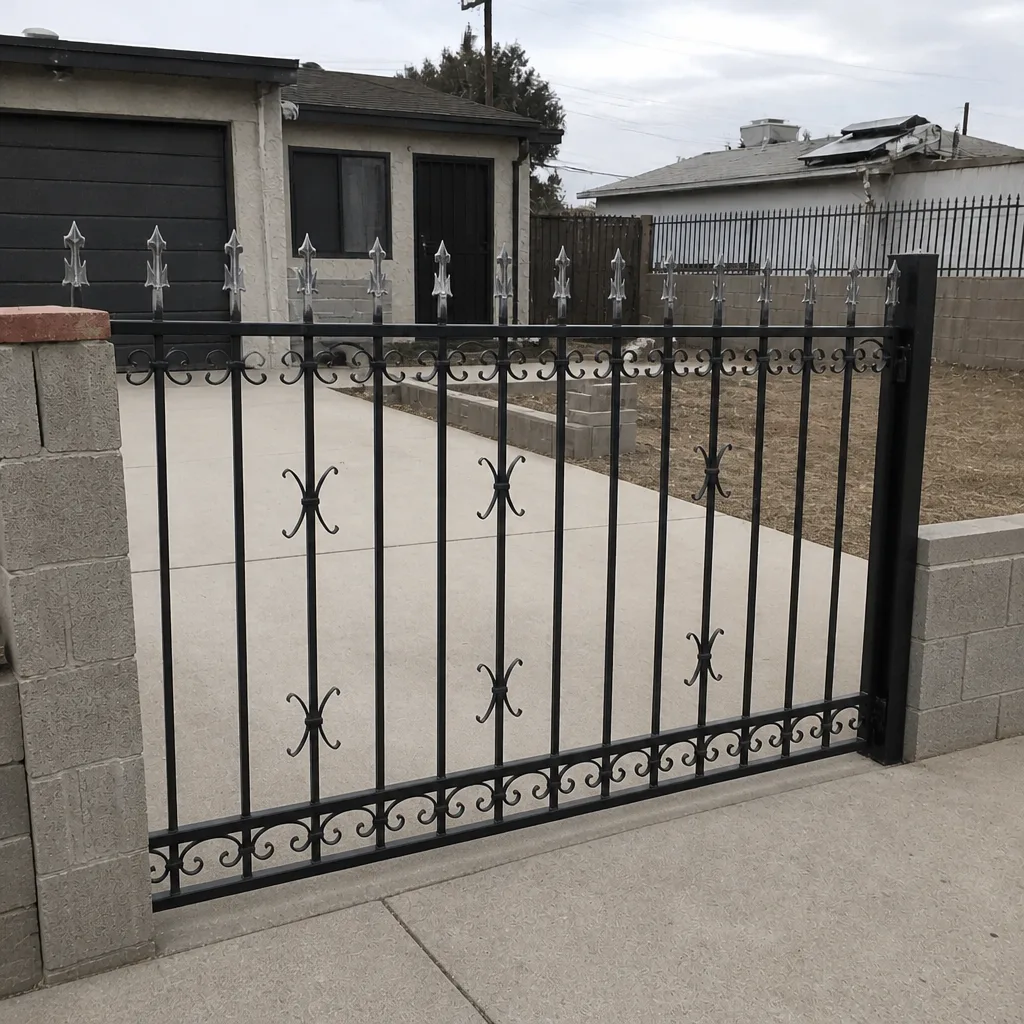
The mix of gate types. Sunrise Manor is a mix of older block-wall driveways with heavy wrought-iron swing gates and newer stucco subdivisions with lighter slide gates. The right operator for one is wrong for the other, and a homeowner installing a slide operator sized for a light aluminum gate on a heavy iron gate is going to burn out the motor inside a year. That’s a sizing question, not a skill question, and it’s the one place where even a very handy person needs to see the numbers before they buy.
Common Mistakes to Avoid
- Wiring photo-eyes to accessory power instead of the entrapment terminals. The eyes will glow and the gate will move, and the safety circuit will be dead. This is the single most common mistake we find on homeowner installs in Sunrise Manor.
- Skipping the reverse test after install. A green LED doesn’t prove the operator reads the safety device. You have to physically interrupt the beam mid-close and confirm the gate reverses.
- Running the 120V feed without a permit. In unincorporated Clark County, outdoor gate circuits need inspection. Skip it and you own the liability if the wiring ever fails.
- Mounting photo-eyes without cleats or standoffs. Direct-to-stucco mounting on an east-valley gate post will drift out of alignment in the first spring wind.
- Buying a generic backup battery. The 7Ah big-box battery won’t match the OEM spec, and it’ll last one outage in the heat here.
- Sizing the operator by price instead of by gate weight. A light-duty slide operator on a heavy iron gate is a burnt motor inside twelve months, no matter how careful the install was.
- Leaving a “force close” override active to make a balky gate behave. That setting exists for maintenance testing, not for permanent use. It disables the entrapment protection, and it’s how people get hurt.
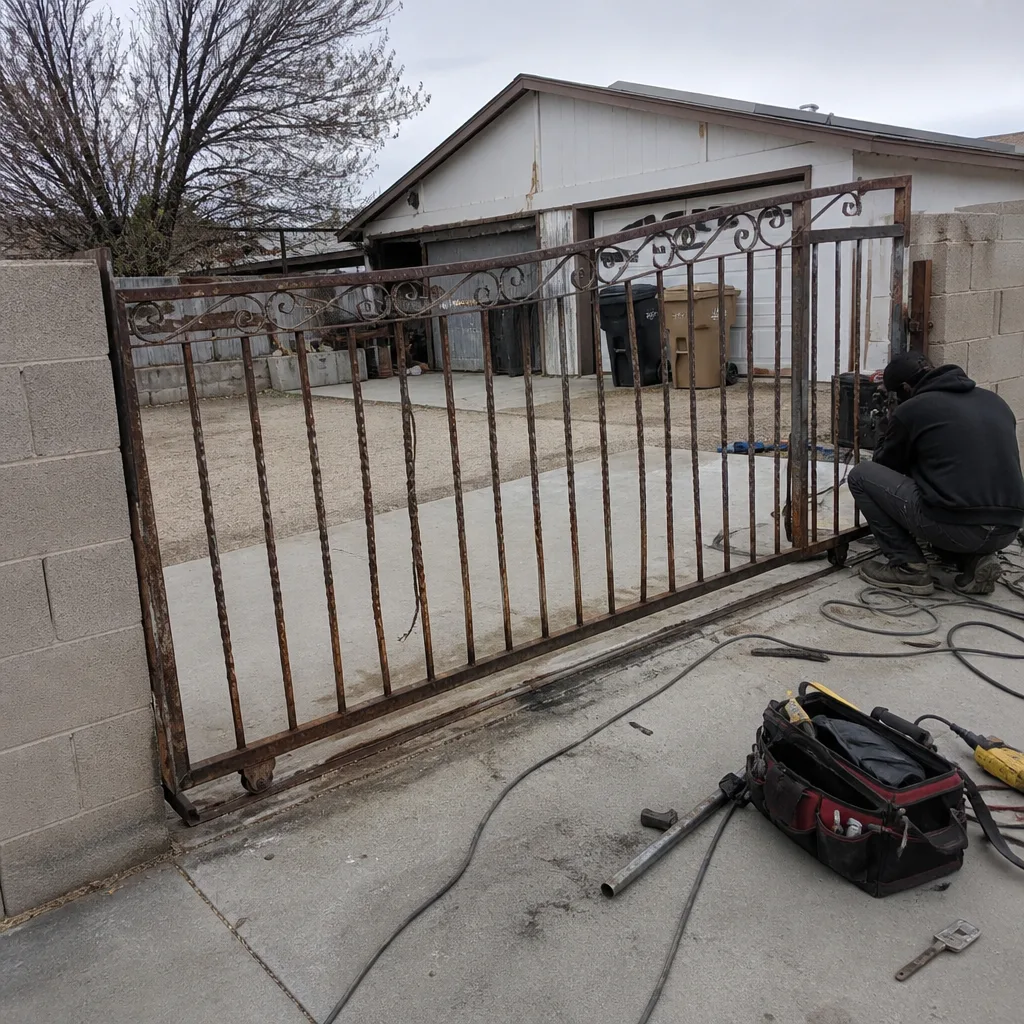
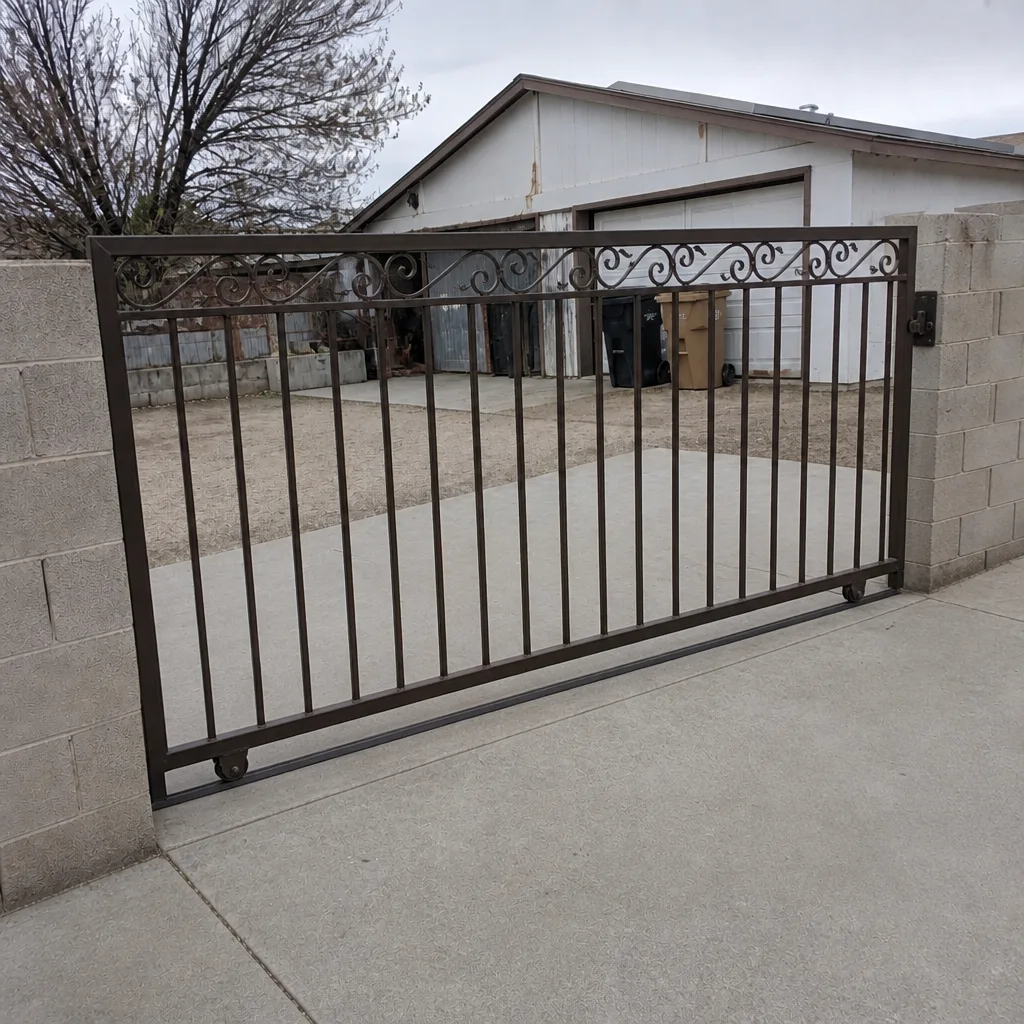
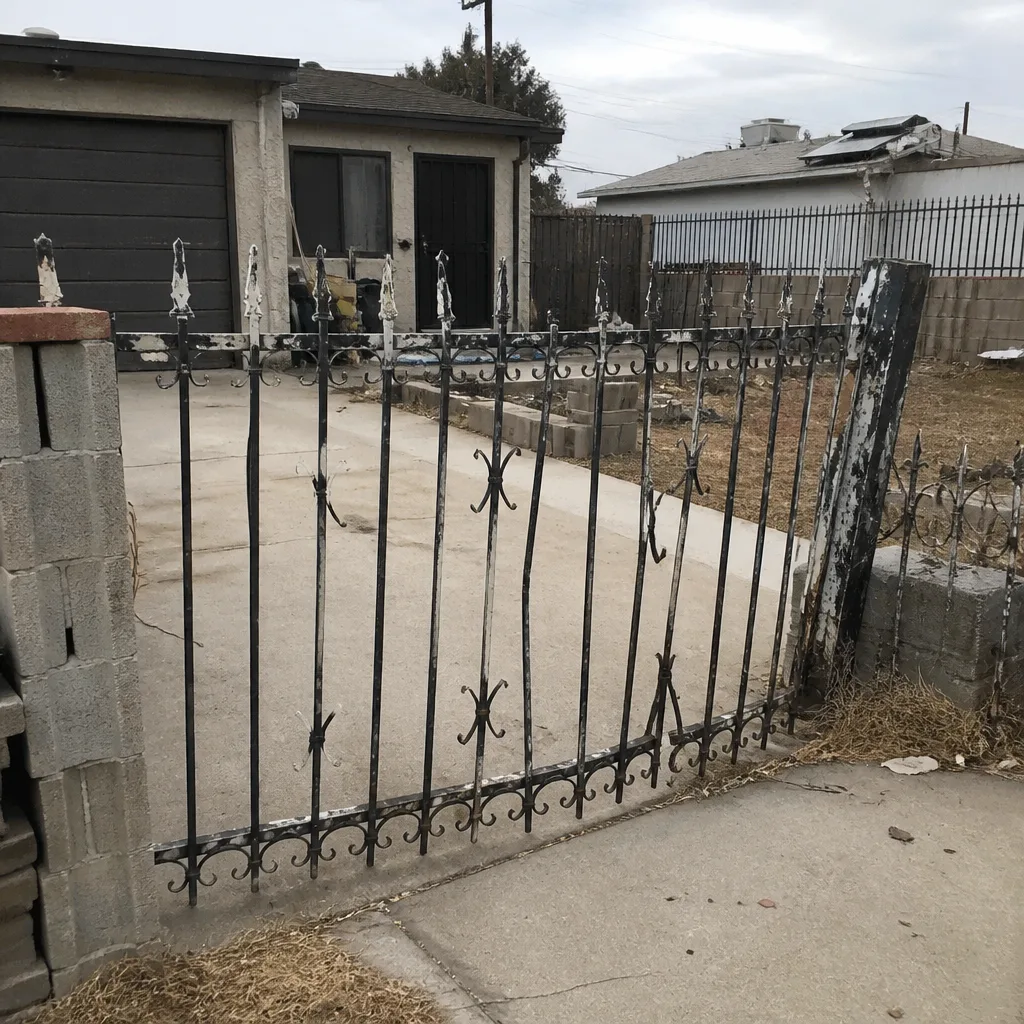
See the difference
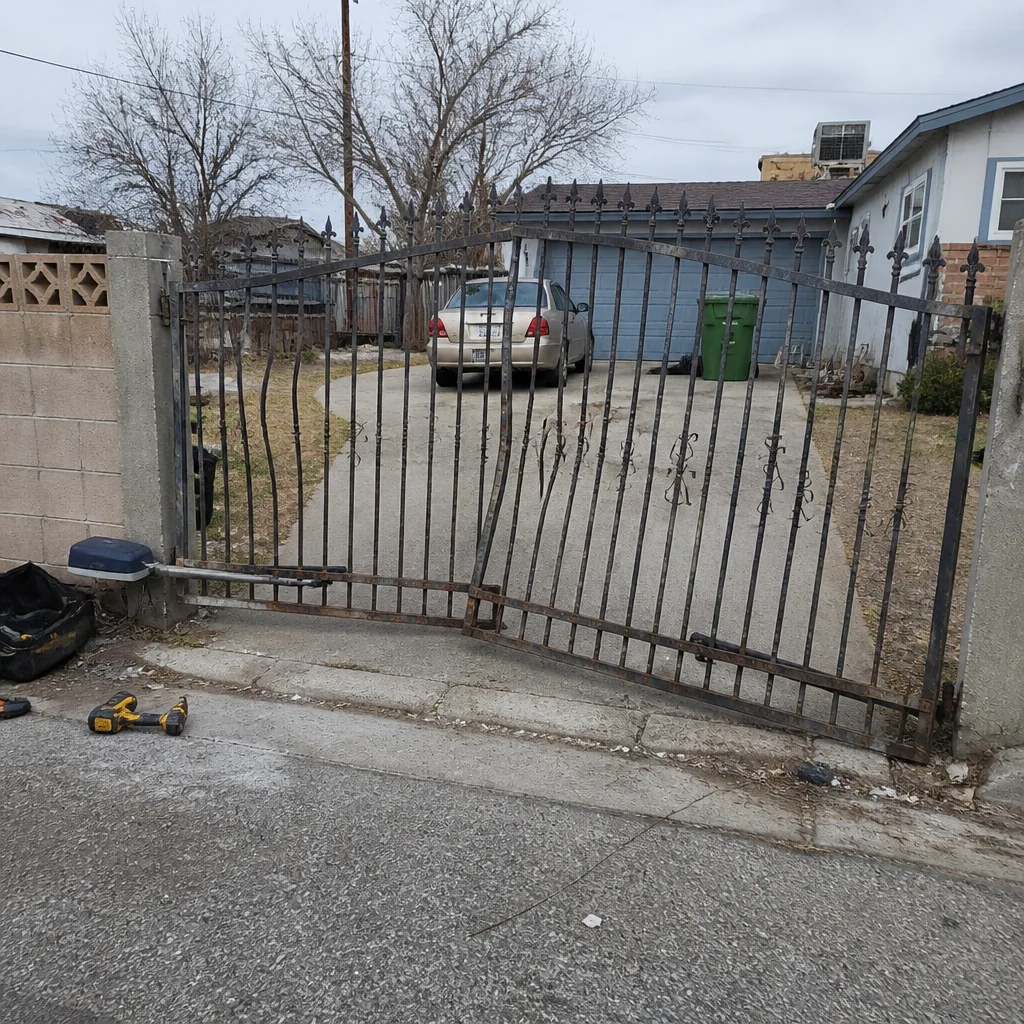 Before
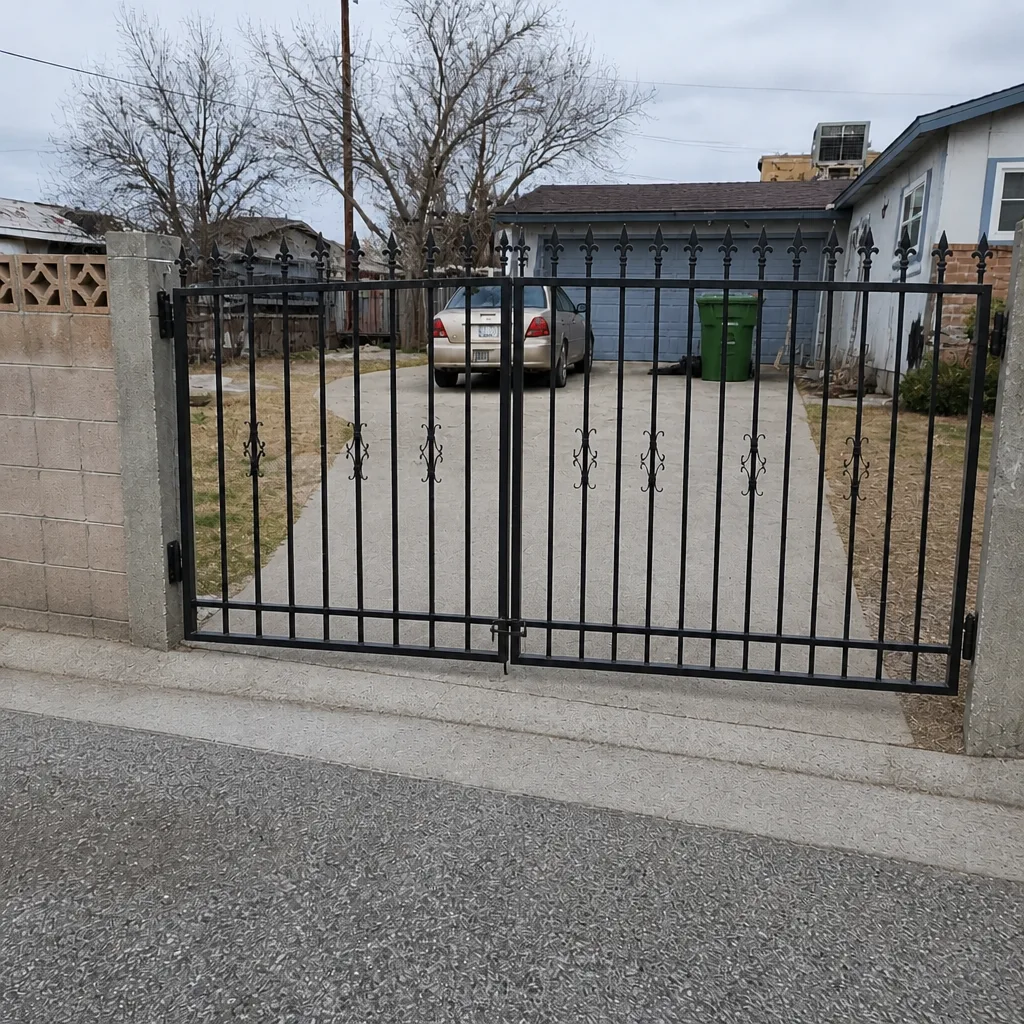 After
 Before
 After
 Before
 After
When to Call a Professional
Call us if the job requires opening the motor housing or touching the wiring inside it. Call us if you’re installing a new operator on a gate that didn’t have one, if you need the electrical run, if you can’t get the reverse test to pass, or if the gate has started sagging since the operator went in. Call us if you bought an operator at a big-box store and the box doesn’t match your gate weight, and you want a straight answer before you open it. And call us if you got part way through a Phase One install and want to know what’s actually safe to keep.
Gatewood Fence & Gate Sunrise Manor offers free estimates in Sunrise Manor – call (844) 761-8729. A live person answers, day or night. If it’s a job we think you should finish yourself, we’ll say so; if it’s a job where DIY is going to cost you more than calling, we’ll show you the numbers. We’re also happy to be a Gate Repair in Sunrise Manor second opinion on a written estimate you already have, no charge, no pressure. If you want to see the whole scope of what we do, start at the Gatewood Fence & Gate Sunrise Manor home page, or look at Gate Installation in Sunrise Manor for how we approach a fresh setup from the gate post out.
Frequently Asked Questions
You can install the mechanical and low-voltage portion yourself if you’re careful and you have a matching operator for your gate weight, but the 120V electrical run and the UL 325 entrapment protection calibration are the parts we recommend to a licensed professional. The electrical run needs a permit in unincorporated Clark County, and a misconfigured safety device is a liability even when it appears to work.
UL 325 is the safety standard that requires automatic gates to reverse when something enters their path, which is why entrapment protection devices exist. It matters because an operator that moves but doesn’t reverse on an obstruction violates the standard, and if a person or pet is injured, the owner of the gate is exposed to liability regardless of who installed it. Every professional install we complete includes a physical reverse test with the homeowner watching.
Yes. Battery replacement on a residential backup is a genuinely safe homeowner task. Kill the breaker, let the gate finish its cycle, swap the sealed battery for the OEM-specified replacement, and restore power. Use the OEM battery rather than a generic one, because the heat in this valley shortens tolerance for a mismatched spec.
Rework cost depends on what failed, but the common failure points are the control board and the wiring, and both are the most expensive components. In our experience, a homeowner who replaces a board, a set of photo-eyes, and part of the wiring before calling has usually spent close to the cost of a proper install. Call (844) 761-8729 for a free estimate on the specific fix; the written number is what you pay.
No. We walk the gate and quote the specific rework that’s needed, not a blanket do-over. What we can warrant is the work we redo and any work we complete; the segments you finished yourself that we didn’t touch are outside the 90-Day Done Right Promise, and we’ll say that plainly before we start.
Often, yes, if it’s a repair like photo-eye alignment, battery replacement, or a limit adjustment on a repair ticket we can get to same-day. Installation and new-operator jobs are scheduled, because we measure and quote before we order the equipment. Call (844) 761-8729 and we’ll tell you honestly which category your job falls into.
The Bottom Line
The “can I do it myself” question has a real answer, and it isn’t about how handy you are. Battery swaps, photo-eye cleaning, remote programming, and limit adjustments on digital operators are safe home tasks and we’ll never charge you to do them. Electrical wiring, entrapment protection calibration, and operator-to-gate geometry are the three categories where DIY produces injuries and liability, and where the money math usually goes the wrong direction. If your job lands in the first list, keep the money. If it lands in the second, call us before you open the box, and we’ll tell you the straight answer, in writing, before a single bolt is turned. Gatewood Fence & Gate Sunrise Manor, (844) 761-8729, free estimates, live person every time.
Written by the team at Gatewood Fence & Gate Sunrise Manor.